Showing posts with label spiritual. Show all posts
Saturday, 7 July 2012 | By: Amandine Ronny Montegerai

Manners Have Limits...


"...Manners have limits. When these limits are crossed, this is transgression. When they are fallen short of, this is deficiency and disgrace.


ANGER has a limit: and it is to be bold while being above having negative and deficient traits, and this is the perfect form of anger. If this limit is exceeded, you become a transgressor. If you fall short of it, you will be a coward and will not be able to raise yourself above negative traits.

COVETOUSNESS has a limit: it is to take all you need from this world and what it has to offer you. When you fall short of this limit, it becomes disgrace and wastefulness. When you exceed this limit, you end up wanting what you shouldn't want.

ENVY has a limit: and it is to compete in becoming perfect and to excel such that your rival is unable to excel over you. When this limit is exceeded, you transgress and oppress in which you wish that the good things are taken away from the one you envy and are keen to harm him. When you fall short of this limit, you become low, weak in aspiration, and you belittle yourself. The Prophet ( ) said: "There should be no envy except in regards to two things: a man who was granted wealth by Allah and he was able to spend it for the sake of the truth, and a man who was granted wisdom by Allah and he takes it and teaches it to the people." So, this is an envy of competition, where the envious one pushes himself to be like the one he envies without wishing that he is deprived of the good things that are with him.

SEXUAL desire has a limit: and it is to relax the heart and mind from the exhaustion of worship, to maintain moral excellence, and to use the fulfillment of these desires to help you in this. When you exceed this limit, you fall into being overly lustful, and you come to resemble animals. When you fall short of this limit and don't use this time to obtain excellence and virtue, this becomes weakness, inability, and disgrace.

RELAXATION has a limit: and it is to collect yourself and your strength to prepare for worship and perfection of the self, and to save this so that you don't become weak or tired. When you exceed this limit, this becomes laziness and waste, and you end up missing out on so many things that could benefit you. When you fall short of this limit, you end up hurting and weakening your energy, and it might even be cut off from you like a farmer who is unable to land to plow or crops to pick.

GENEROSITY has a limit between two extremes: and whenever this limit is exceeded, this becomes wastefulness and extravagance. When you fall short of this limit, you become cheap and miserly.

BRAVERY has a limit: and when you cross this limit, you become reckless. When you fall short of this limit, you become a coward. This limit is that you put yourself forth when the time is right to do so and that you hold yourself back when the time is right to do so, just like Mu'awiyah said to 'Amr bin al-'As: "I don't know whether you're brave or cowardly! You go forth to the point that I say you're the bravest person, and then you stay back to the point that I say you're the most cowardly person!" So, he replied:
I am brave if I am guaranteed the chance * If I don't have the chance, I am a coward...

PROTECTIVE JEALOUSY has a limit: and if you exceed this limit, you fall into accusation and suspicion of the innocent. If you fall short of this limit, you fall into heedlessness and lack of manhood.

HUMILITY has a limit: and if it is crossed, this becomes humiliation and disgrace. If you fall short of it, you deviate to arrogance and false pride.

HONOR has a limit: and if you exceed it, you fall into arrogance and blameworthy traits. If you fall short of it, you deviate to humiliation and disgrace.

The basic principle in all this is to choose the path of moderation between excess and negligence. This is what all of the benefits of this world and the next are built upon. In fact, you can benefit your body in no other way, because when some of your activities are done with lack of moderation and either exceed or fall short of it, your body's health and energy begins to decline accordingly. Likewise, natural activities such as sleeping, staying awake, eating, drinking, having intercourse, playing sports, spending time alone, spending time with others, etc. - if these are all done moderately between the two blameworthy extremes, this is justice. If you deviate to either extreme, this is a sign of deficiency and will lead to even more deficiency.

This knowledge of proper limits is from the best types of knowledge, especially the limits of what is commanded and prohibited. The most knowledgeable people are those who know the most about these limits, such that they don't put in them what doesn't belong and don't remove from them what does belong. Allah Said:

"The bedouins are the worst in disbelief and hypocrisy, and more likely to be ignorant of the limits that Allah has revealed to His Messenger... " [Quran 9:97]

So, the people who are most just are those who recognize by way of knowledge and action the legislated limits in their manners and deeds, and Allah is the source of success..."

by Ibn Al-Qayyim 

Source : Wikipedia 
Tuesday, 24 April 2012 | By: Amandine Ronny Montegerai

Faith or Fiction?


Arguably, one of the greatest scenes in all of movie history is the parting of the Red Sea by Moses played by Charlton Heston in the blockbuster epic The Ten Commandments. (The awe inspired by the portrayal of the miracle during the Israelites’s exodus from Egypt is matched only by the awe that movie special effects have come a long way since 1956.) Cheesy? Yes. Biblically accurate? Basically. Scientifically feasible? Possibly, say a team of scientists.

The team of researchers from the National Center for Atmospheric Research (NCAR) and the University of Colorado (UC) at Boulder recently published results of a study of wind dynamics and water in the online peer-reviewed journal, PLoS ONE. As part of the larger study, the scientists described how strong winds could have pushed back water at a point where the Nile River bent to meet a coastal lagoon, creating a land bridge for safe travel across once sea-covered terrain.

The authors explain that winds of 63 miles per hour, blowing continuously for 12 hours, could have pushed back water 6 feet deep. The land bridge created would have been approximately 2 to 2.5 miles long and 3 miles wide. It would have remained open for 4 hours — plenty of time for the Israelites to escape Pharaoh’s approaching armies. As in the biblical account, the authors maintain once the wind stopped blowing, the waters would have returned to their original position, drowning anyone who was in the way (that is, Egyptian soldiers.)
In order to construct the computer models and perform the necessary mathematics, the team of NCAR–UC researchers reconstructed likely locations of the great water crossing, but the exact location of the parting of the waters in the Bible are not known and the topography and locations and depths of Mediterranean water ways have shifted dramatically in the 3000 years since the exodus.

Many scientific studies have examined the mysteries and miracles in the Bible. Some present evidence of the age of the earth that matches estimations found in the Bible. Others assert that human DNA carries evidence of the existence of Adam and Eve. Still others support cosmic theories based on Biblical text. A study similar to the current NCAR-UC analysis provides geological evidence for Noah’s flood.

But, none of these studies bring anyone any closer to any real answers. People of faith do not need scientific proof of God’s actions as found in the Bible. The miracles themselves are the proof of the existence of a higher power, even if they are contradictory to experience. The faith required for belief in a higher power, by definition, does not require material evidence.

While science and religion seem to contradict each other sometimes, they need not be mutually exclusive. Some of the greatest scientists in history were people of great faith and religious beliefs. Albert Einstein even wrote, “Science without religion is lame; Religion without science is blind.” Believers simply believe that there are certain things that science cannot and will not explain. The gap between where science stops and a higher power begins is filled with gray area and unanswered questions, but it is faith that allows religious followers to find comfort in not knowing all the answers.

Many scientific explanations of Biblical miracles, such as the parting of the Red Sea, still leave too many questions unexplained to say that God did not have a hand in the wind and the water the day that the Israelites needed a quick getaway. But, for people that need a nudge toward religion, the studies might provide the substantiation required for a leap of faith. While the current study does not provide clear proof of Biblical events, it does not contradict them, either.

Science and religion are not opposing forces that one must choose between. Believers in a higher power do not have to suspend acceptance of all science, but do acknowledge that there are acts that might not be constrained by the laws of nature. The current study provides an interesting perspective on an astonishing phenomenon that has marveled believers and nonbelievers for nearly 3000 years. It is interesting food for thought, but people who need evidence of the existence of a divine being will not find it here, nor will people who want to disprove the existence. And, people who already believe do not need scientific proof, anyway.

References
Drews C, & Han W (2010). Dynamics of wind setdown at Suez and the Eastern Nile Delta.PloS one, 5 (8) PMID: 20827299
Flannelly KJ, Galek K, Kytle J, & Silton NR (2010). Religion in America–1972-2006: religious affiliation, attendance, and strength of faith. Psychological reports, 106 (3), 875-90 PMID: 20712176
Krauss LM. Faith and Foolishness: When Religious Beliefs Become DangerousScientific American, 2010 August 3, 2010.


Friday, 13 April 2012 | By: Amandine Ronny Montegerai

The bible vs. The book of Mormon


The Secret World of Mormonism - Mormon Cartoon


Non-believers have their own reasons for not wanting a religious president in the white house (look at the Bush Jr. years for an example) but it seems that other Christian groups also take a hard stance against the Mormons even to the extent of producing films which educate the public on the strange beliefs of Mormons. Of course "strange" is in the eye of the beholder as what one considers strange certainly depends on one's viewpoint.
Then again the Mormons have a lot of weird customs and beliefs - the holy underwear, the racism, the sexism, the polygamy thing, no caffeine/alcohol, the offering of the book of Mormon to ancestors, the huge hot tubs on the backs of oxen, Jesus in America, blaming wagon train massacres on the Native Americans etc. Plus the fact that the whole religion was started by a con man who was run out of town and threaten by castration. If you don't know what I'm talking about the you don't know enough about the religion. I suggest you start with "Under The Banner Of Heaven" by the always excellent Jon Krakauer and then perhaps take in the new Broadway show "The Book of Mormon".
The following cartoon, banned by Youtube after pressure from the powerful and rich Mormon church explains some of the teachings of founder Joseph Smith and his golden tablets which he claimed contain missing parts of the bible.


Thursday, 12 April 2012 | By: Amandine Ronny Montegerai

Naraka (Buddhism)


Naraka नरक (Sanskrit) or Niraya निरय (Pāli) (Ch: 那落迦 (variant 捺落迦) Nàlùojiā or 地獄 Dì YùJp: 地獄 Jigoku or 奈落 NarakuBurmeseငရဲ nga-ye;Tib: དམྱལ་བ་ dmyal ba;Thai: นรก nárókMalay neraka) is the name given to one of the worlds of greatest suffering in Buddhist cosmology.
Naraka is usually translated into English as "hell", "hell realm", or "purgatory". The Narakas of Buddhism are closely related to diyu (地獄), the hell of Chinese mythology. A Naraka differs from the hells of Abrahamic religions in two respects. First, beings are not sent to Naraka as the result of a divine judgment and punishment; second, the length of a being's stay in a Naraka is not eternal, though it is usually very long.
Instead, a being is born into a Naraka as a direct result of his or her accumulated karma and resides there for a finite period of time until that karma has achieved its full result. After his or her karma is used up, he or she will be reborn in one of the higher worlds as the result of karma that had not yet ripened.
In the Devaduta Sutta, the 130th discourse of Majjhima Nikaya, the Buddha teaches about hell in vivid detail.
Physically, Narakas are thought of as a series of cavernous layers which extend below Jambudvīpa (the ordinary human world) into the earth. There are several schemes for enumerating these Narakas and describing their torments. The Abhidharma-kosa (Treasure House of Higher Knowledge) is the root text that describes the most common scheme, the Eight Cold Narakas and Eight Hot Narakas, described below.

Naked and climbing thorn-covered trees, these figures are pecked by birds from above and attacked by demons with spears below. Icy mountains are in the background.
Cold Narakas


  • Arbuda – the "blister" Naraka. This is a dark, frozen plain surrounded by icy mountains and continually swept by blizzards. Inhabitants of this world arise fully grown and abide life-long naked and alone, while the cold raises blisters upon their bodies. The length of life in this Naraka is said to be the time it would take to empty a barrel of sesame seed if one only took out a single seed every hundred years.

  • Nirarbuda – the "burst blister" Naraka. This Naraka is even colder than the one above, and here the blisters burst open, leaving the beings' bodies covered with frozen blood and pus.

  • Aṭaṭa – the Naraka of shivering. Here the beings shiver in the cold, making an aṭ-aṭ-aṭ sound with their mouths.
  • Hahava – the Naraka of lamentation. Here the beings lament in the cold, going ha, ho in pain.
  • Huhuva – the Naraka of chattering teeth. Here the beings shiver as their teeth chatter, making the sound hu, hu.
  • Utpala – the "blue lotus" Naraka. Here the intense cold makes the skin turn blue like the color of an utpala waterlily.
  • Padma – the "lotus" Naraka. In this Naraka the blizzard cracks open the frozen skin leaving one raw and bloody.
  • Mahāpadma – the "great lotus" Naraka. Here the whole body cracks into pieces and the internal organs are exposed to the cold and they also crack.
Each lifetime in these Narakas is twenty times the length of the one before it.

Human-animal figures are cut and disemboweled by demons and birds, while Mālaya looks on from above.

Hot Narakas


  • Sañjīva – the "reviving" Naraka. In this Naraka the ground is made out of hot iron heated by an immense fire. Beings in this Naraka appear fully grown, already in a state of fear and misery. As soon as the being begins to fear being harmed by others, their fellows appear and attack each other with iron claws. Or else, the attendants of Yama appear and attack the being with many fiery weapons. As soon as the being experiences an unconsciousness like death, they are suddenly restored to full health and the attacks begin again. Other tortures experienced in this Naraka include having molten metal dropped upon them, being sliced into pieces, and suffering from the heat of the iron ground. Life in this Naraka is 1.62×10¹² years long. It is said to be 1000 yojanas beneath Jambudvīpa and 10,000 yojanas in each direction.

  • Kālasūtra – the "black thread" Naraka. Here, in addition to the torments mentioned above, black lines are drawn upon the body, and Yama's servants cut the beings upon the lines with fiery saws and sharp axes. Life in this Naraka is 1.296×10¹³ years long.

  • Saṃghāta – the "crushing" Naraka. This Naraka is also upon a ground of hot iron, but is surrounded by huge masses of rock that smash together and crush the beings to a bloody jelly. When the rocks move apart again, life is restored to the being and the process starts again. Life in this Naraka is 1.0368×10¹⁴years long.
  • Raurava – the "screaming" Naraka. Here beings run wildly about, looking for refuge from the burning ground. When they find an apparent shelter, they are locked inside it as it blazes around them, while they scream inside. Life in this Naraka is 8.2944×10¹⁴ years long.
  • Mahāraurava – the "piercing" Naraka. Punishment in here are for people who maintain their own body by hurting others. In this hell, ruru animals known as kravyāda torment them and eat their flesh. Life in this Naraka is 6.63552×10¹⁵ years long.
  • Tapana – the "heating" Naraka. Here Yama's servants impale the beings on a fiery spear until flames issue from their noses and mouths. Life in this Naraka is 5.308416×10¹⁶ years long.
  • Pratāpana – the "great heating" Naraka. The tortures here are similar to the Tapana Naraka, but the beings are pierced more bloodily with a trident. Life in this Naraka is 4.2467328×10¹⁷ years long. It is also said to last for the length of half an antarakalpa.
  • Avīci – the "uninterrupted" Naraka. Beings are roasted in an immense blazing oven with terrible suffering. Life in this Naraka is 3.39738624×10¹⁸ years long. It is also said to last for the length of an antarakalpa.
These Narakas by no means exhaust the tale of possible sufferings. Some sources describe five hundred or even hundreds of thousands of different Narakas. In Chinese Buddhist texts, the numbers and types of Narakas were elaborated in a variety of creative ways; see Di Yu for examples of this sort of treatment.
The sufferings of the dwellers in Naraka often resemble those of the Pretas, and the two types of being are easily confused. The simplest distinction is that beings in Naraka are confined to their subterranean world, while the Pretas are free to move about.

Isolated Narakas

There are also isolated and boundary hells called Pratyeka-narakas (Pali: Pacceka-niraya) and Lokantarikas.

Naraka in the Burmese representation

Narakas in Buddhist literature


Descriptions of the Narakas are a common subject in some forms of Buddhist commentary and popular literature, as cautionary tales against the fate that befalls evildoers and an encouragement to virtue.

The Mahāyāna Sūtra of Bodhisattva Kṣitigarbha (Dìzàng or Jizō) graphically describes the sufferings in Naraka and explains how ordinary people can transfermerit in order to relieve the sufferings of the beings there.

A traditional Chinese Buddhist story of Mulian (Maudgalyayana) explains how this disciple of the Buddha spiritually journeyed to Naraka to help his mother, who had been reborn there, obtain a better rebirth.
The Japanese monk Genshin began his Ōjōyōshū with a description of the suffering in Naraka. Tibetan Lamrim texts also included a similar description.
Chinese Buddhist texts considerably enlarged upon the description of Naraka (Dì Yù), detailing additional Narakas and their punishments, and expanding the role of Yama and his helpers, Ox-Head and Horse-Face. In these texts, Naraka became an integral part of the otherworldly bureaucracy which mirrored the Imperial Chinese administration.

References


Wednesday, 11 April 2012 | By: Amandine Ronny Montegerai

Avici


In BuddhismAvīci (Sanskrit and Pali: "without waves"; also transliterated AvichiJapanese and Chinese language: 無間地獄, むげんじごく and 阿鼻地獄, あびじごく) is the lowest level of the Naraka or "hell" realm, into which the dead who have committed grave misdeeds may be reborn. It is said to be a cube 20,000 yojanas to a side.
People reborn in Avīci generally have committed one or more of the Five Grave Offenses:
  • Intentionally murdering one's father
  • Intentionally murdering one's mother
  • Killing an Arhat (enlightened being)
  • Shedding the blood of a Buddha
  • Creating a schism within the Sangha, the community of Buddhist monks and nuns.
Buddhism teaches that rebirth into Naraka is temporary, while the offending being works off the karma they performed. Similarly, rebirth into Avīci hell is not eternal. However, suffering in Avīci is the longest of all the levels of hell, by some accounts over 1018 years long. Some sutras state that rebirth in Avīci will be for innumerable kalpas (eons). When the offending being passes away after one kalpa, he is again reborn in the same place, undergoing suffering for another kalpa, and on and on until he has exhausted his bad karma. For this reason, Avīci hell is also known as the "non-stop way" (無間道).
Nichiren famously wrote that Buddhist monks who ignored the passages in the Lotus Sutra, which claimed its superiority over other sutras would fall into the Avīci hell. Outside of Nichiren, it is extremely rare for a Buddhist monk to condemn anyone to Avīci hell. Although the Lotus Sutra itself states "when his [those who slander] life comes to an end, he will enter the Avichi Hell."
Rebirth in Avīci (or any lower realm for that matter) should be seen as a process of purification rather than a form of punishment as there is no supernatural being that determines anyone's fate of its own will and everyone is responsible for their own actions and their consequences: "[...]beings are owners of kamma, heir to kamma, born of kamma, related through kamma, and have kamma as their arbitrator. Kamma is what creates distinctions among beings in terms of coarseness & refinement." Thus, being reborn in Avīci is purely the inevitable result of one's evil deeds and not the decision of, for example, a malevolent deity.
Wednesday, 21 March 2012 | By: Amandine Ronny Montegerai

Jesus Weeping...


A woman finds this Image of Jesus holding a human baby and it leads to a real miracle, she is healed of cancer

Used with permission from visionary Valentina Papagna.

February 1, 2005 - The original picture belongs to a very good friend of Valentina's called Edda. She came across it in Berrima, NSW. Edda suddenly saw it fall by her feet on the ground during the prayers of the Stations of the Cross about seven years ago. Edda was surprised and as she picked it up she looked around to see if it belonged to anybody, the only people in sight were quite a distance away and it did not belong to them.

She decided to leave the image in the church believing it had to belong to someone. Much later nobody had claimed it so Edda took it home because of the unusual circumstances she had discovered it in. At the time, and even not that long ago what appeared in the palm of Jesus' hands were 5 hosts - many can confirm that. Edda asked Valentina what it might mean (to present it to our Lord). Valentina told her friend that she must pray for the unborn. And that was that.

Now, just recently the image unmistakably presents a tiny baby in the palm of Jesus' hands. It was requested if Valentina could post the image on her website and she was delighted.

It is simply a picture of Jesus, like all holy pictures we come across, with similarities to how Jesus really looks. In Valentina's visions the beauty of Jesus she says, "I cannot describe. He has a brilliant beauty".

Valentina also has this to say about the history of the picture:

The picture was meant for My friend Edda to pick up. Edda was very sick with cancer. We prayed for her in the hospital and prayed to the Infant Jesus of Prague. I sent Him to her and asked Him to touch her and heal her. A day later Our Lord responded, "I have done what you asked of Me".

He had been to her and Edda actually saw Him near her bedside in the hospital. She felt happy and peaceful. Our Lord gave her peace after that encounter and the doctors did not find traces of cancer which were progressing quickly.

Of course when our Lord gives us graces He asks for something in return and to thank Him everyday. Jesus told me that Edda should pray for the unborn children, the aborted ones.
 

Monday, 19 March 2012 | By: Amandine Ronny Montegerai

Rama Navami – the Birthday of Lord Rama


Ram Navami, or Ramanavami, is celebrated as the birthday of Lord Rama and it falls on the ninth day of Shukla Paksha (waxing phase of moon) in the month of Chaitra (March – April). In 2011, the date of Ram Navami is April 12. Ramanavami also marks the end of the Chaitra Navratri. Lord Rama is the seventh incarnation of Lord Vishnu.
Rama Navami (Devanagari: राम नवमी) also known as Sri Rama Navami ( IAST Sri Rama-navami ). Sri Ram Navami is a great festival in India, celebrating the birth of Lord Rama to King Dasharatha and Queen Kausalya of Ayodhya. Rama is the 7th incarnation of the Dashavatara of Vishnu. The festival falls in the Shukla Paksha on the Navami, the ninth day of the month of Chaitra in the Hindu calendar. Thus it is also known as Chaitra Masa Suklapaksha Navami, and marks the end of the nine-day Chaitra-Navratri celebrations. 
The ancient story of Ramayana and the tale of Rama has been a part of the vedic culture for a very long time. Rama is one of the most potent incarnations of the Lord Vishnu, who appeared to destroy the mighty Ravana. The festival of Rama Navami is celebrated by Hindus to remember the auspicious nine days of Rama’s life when he was born. The birth of the young Lord Rama is celebrated during the 9 days that end on the ninth day of the month of Chaitra, the final month of the Hindu calendar. The day is generally also known as Chaitra Navaratri to mark the birth of Lord Rama.
The Tenth Chapter of the Ninth Canto of Srimad Bhagavatam describes how Lord Ramachandra appeared in the dynasty of Maharaja Khatvanga.
It also describes the Lord’s activities, telling how He killed Ravana and returned to Ayodhya, the capital of His kingdom.
The son of Maharaja Khatvanga was Dirghabahu, and his son was Raghu. The son of Raghu was Aja, the son of Aja was Dasaratha, and the son of Dasaratha was Lord Ramachandra, the Supreme Personality of Godhead. When the Lord descended into this world in His full quadruple expansion-as Lord Ramachandra, Lakshmana, Bharata and Satrughna, great sages like Valmiki who were actually in knowledge of the Absolute Truth described His transcendental pastimes. Srila Sukadeva Gosvami describes these pastimes in brief.
In the arena of the sacrifice performed by Visvamitra, when He was just a young boy Lord Ramachandra, helped the great sage by killing Subahu and striking Marica, the she-demon, who was disturbing the sages in their daily discharge of duties.
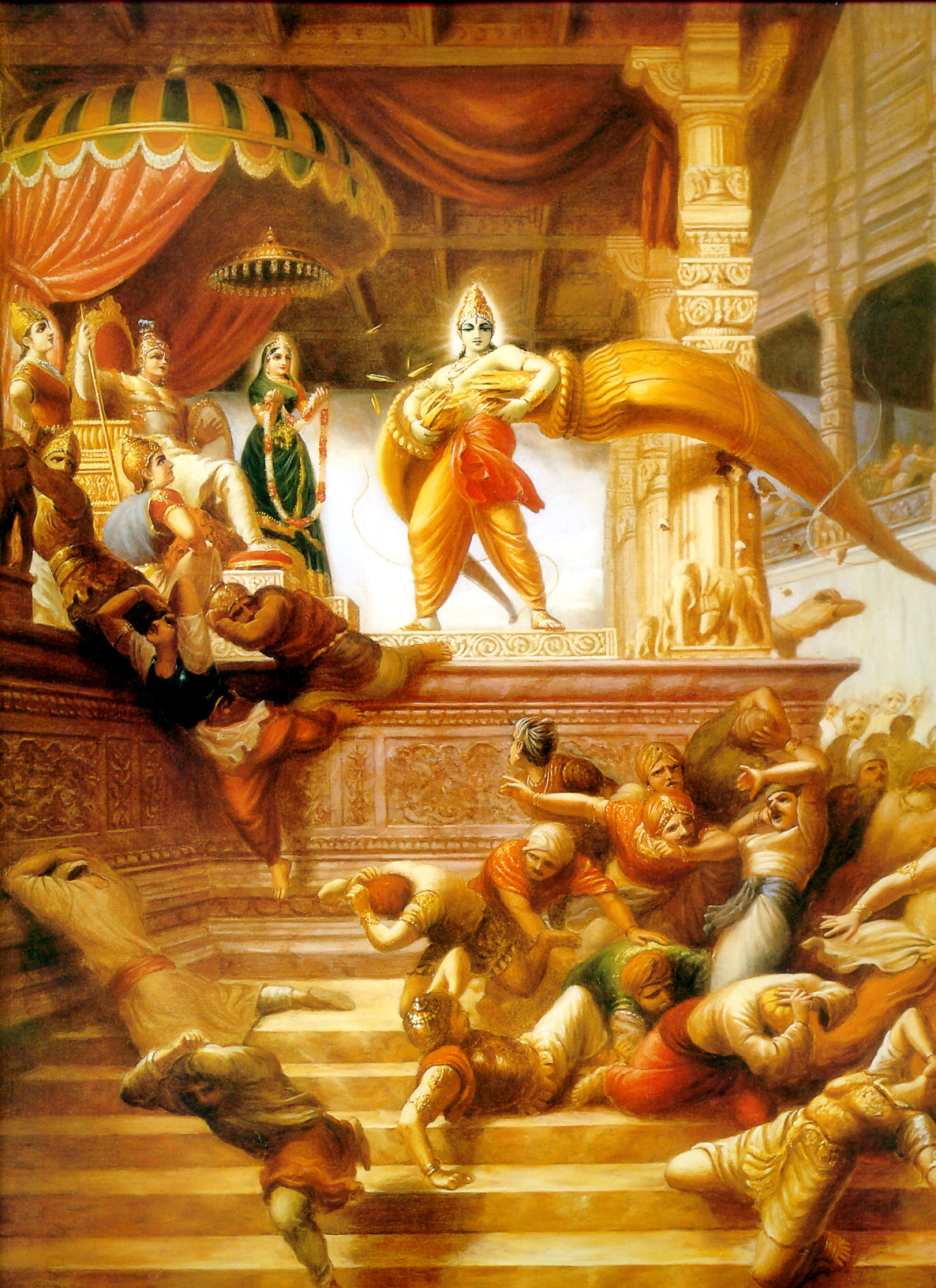
In the assembly where mother Sita was to choose her husband, in the midst of the heroes of this world, He broke the bow belonging to Lord Shiva. Thus the Lord achieved the hand of mother Sita, who was indeed the goddess of fortune who constantly rests on the chest of the Lord. While returning from Sita’s home, Lord Ramachandra met Parasurama. Although Parasurama was very proud, having rid the earth of the royal order twenty-one times, he was defeated by the Lord, who appeared to be a ksatriya of the royal order.
Maharaja Dasaratha had three wives. One of them, Kaikeyi, served him very pleasingly, and he therefore wanted to give her a benediction. At the time of the coronation of Prince Ramachandra, Kaikeyi requested her husband to enthrone her son Bharata and send Ramachandra to the forest. Maharaja Dasaratha, being bound by his promise, ordered Ramachandra to go to the forest. And the Lord, as an obedient son, accepted the order immediately and entered the forest, accompanied by Lakshmana and Sita.
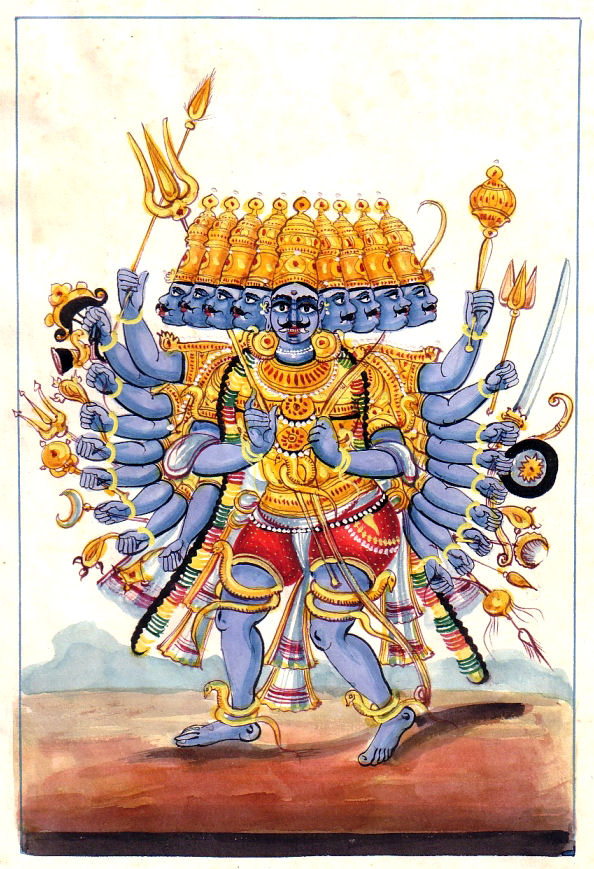
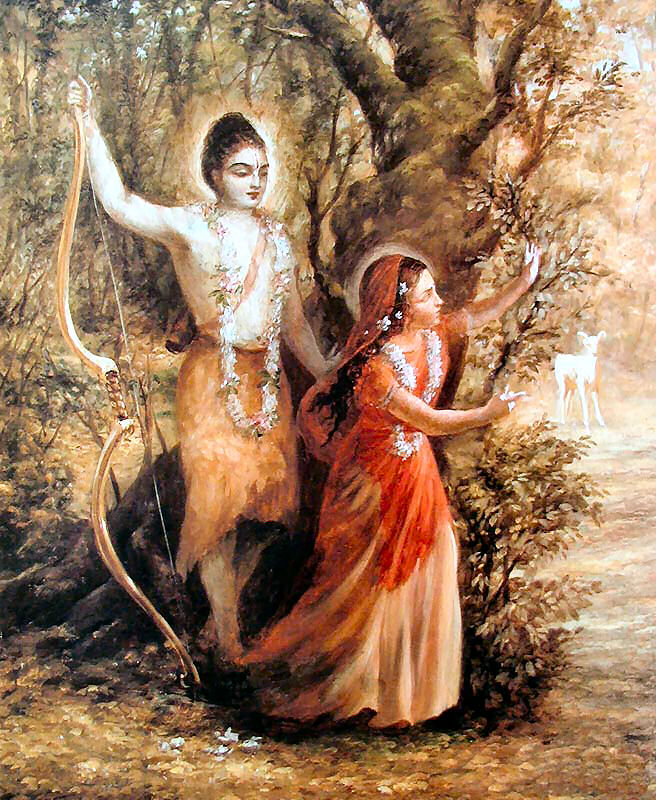
While wandering in the forest, where He accepted a life of hardship, carrying His invincible bow and arrows in His hand, Lord Ramachandra deformed Ravana’s sister, who was polluted with lusty desires, by cutting off her nose and ears. He also killed her fourteen thousand Raksasa friends, headed by Khara, Trisira and Dusana. When Ravana, who had ten heads on his shoulders, heard about the beautiful and attractive features of Sita, his mind was agitated by lusty desires, and he went to kidnap her. Ravana’s kidnapping of Sitadevi was the beginning of this demon’s misfortune. When Marica (a magician) assumed the form of a golden deer, Lord Ramachandra went to bring the deer to please Sitadevi, but in the meantime Ravana took advantage of the Lord’s absence to kidnap her.
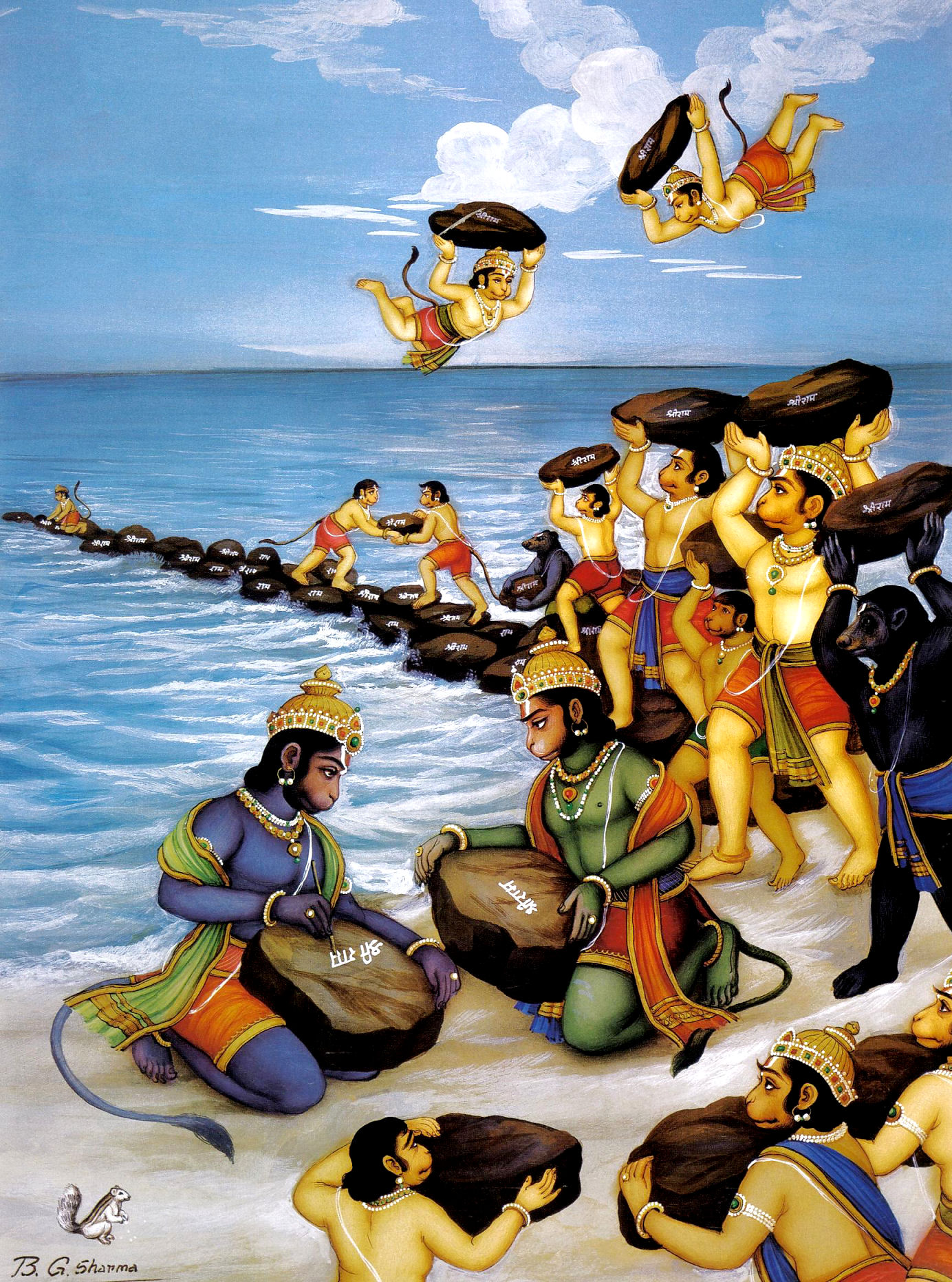
Then the Lord killed the demon Kabandha and the commander Vali and established a friendly relationship with Sugriva. After organizing the military strength of the monkeys He went with them to the shore of the sea. Then Samudra came to the Lord and surrendered to Him, wanting to help Him in every way. Samudra told that his water will present no impediment to Lord’s going to Lanka, but requested Lord Ramachandra to construct a bridge over it to spread His transcendental fame.
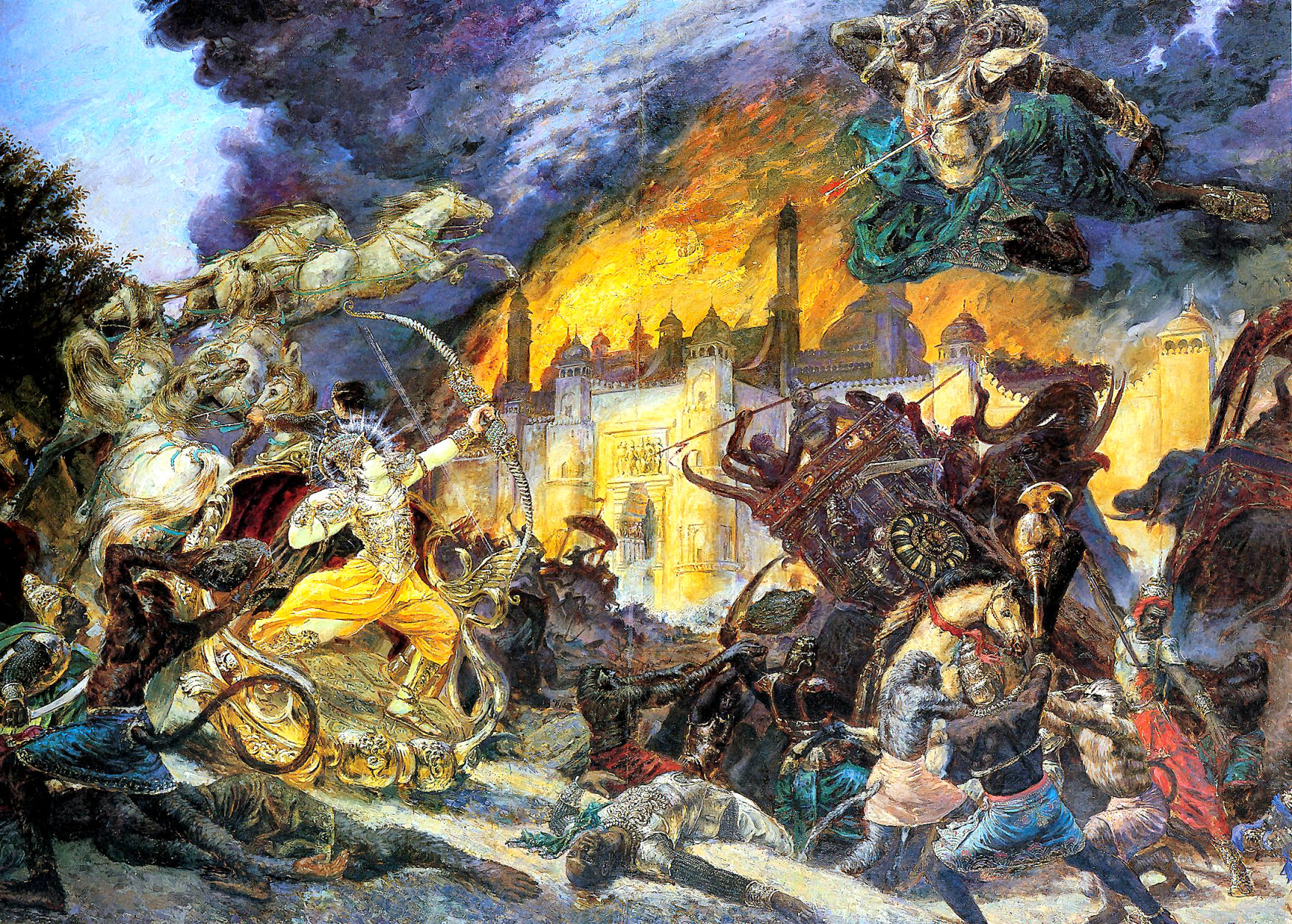
Great mountain peaks covered with trees and plants were thrown into the sea by the monkey soldiers and began to float by the supreme will of the Lord. Thus constructiong the bridge, with the direction and help of Vibhisana, Ravana’s brother, the Lord, along with the monkey soldiers, headed by Sugriva, Nila and Hanuman, entered Ravana’s kingdom. Previously, Hanuman, the eternal servant of the Lord, had set fire to Lanka, and now, the entire city of Lanka was disturbed by the monkey soldiers. When Ravana saw these, he called for Nikumbha, Kumbha, Dhumraksa, and other Rakshasas and also his son Indrajit. Thereafter he called for Prahasta, Atikaya, Vikampana and finally Kumbhakarna. Then he induced all his followers to fight against the enemies.
Lord Ramachandra, surrounded by Lakshmana and monkey soldiers attacked the soldiers of the Rakshasas, who were fully equipped with various invincible weapons. But because the soldiers of Ravana were condemned by the curse of mother Sita, the monkeys were able to kill them simply by throwing stones and trees. Lord Ramachandra rebuked Ravana for his shameful act and then He fixed an arrow to His bow, aimed at Ravana, and released the arrow, which pierced Ravana’s heart like a thunderbolt. Ravana, vomiting blood from his ten mouths, fell from his airplane and was thus killed.
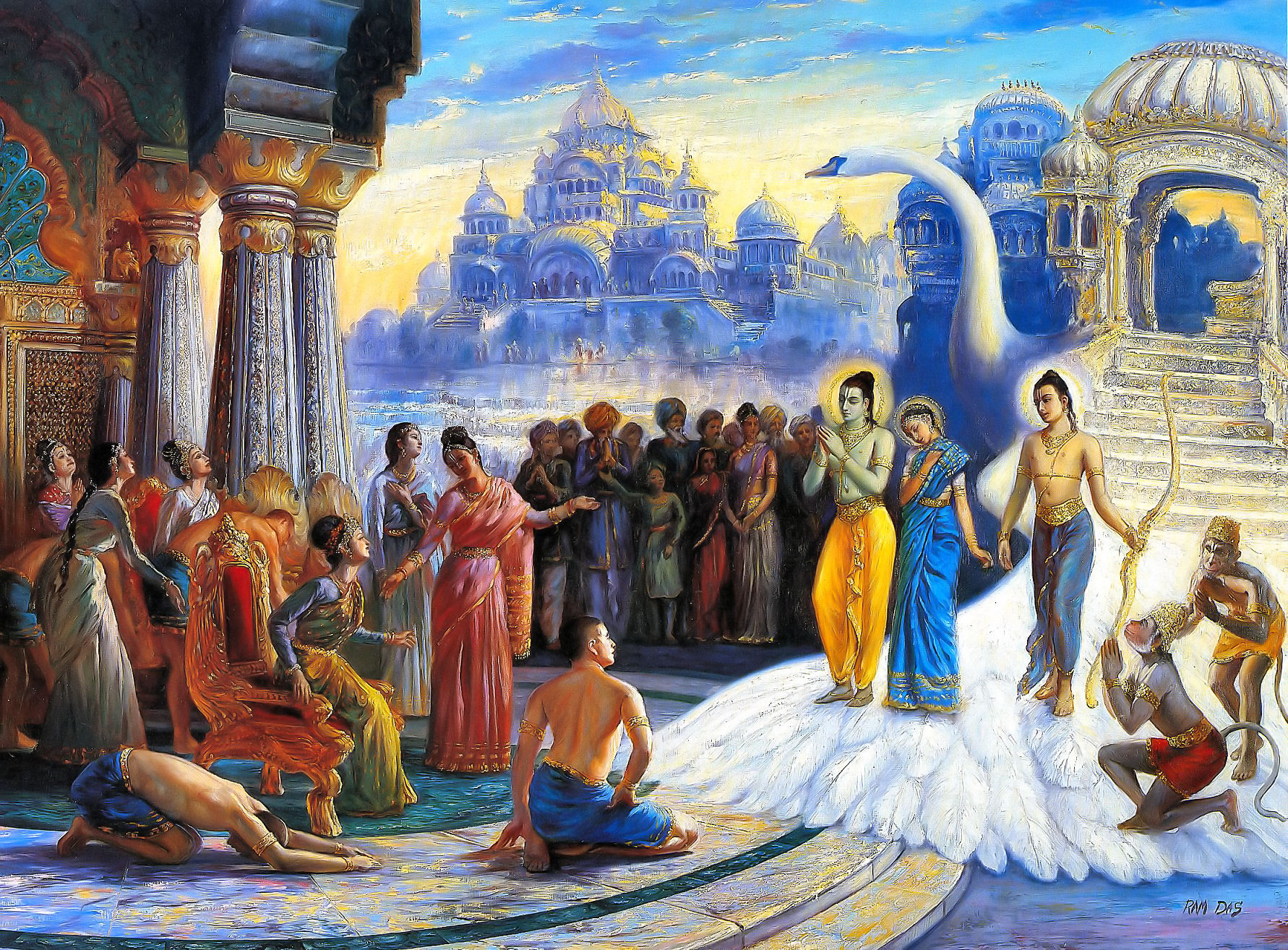
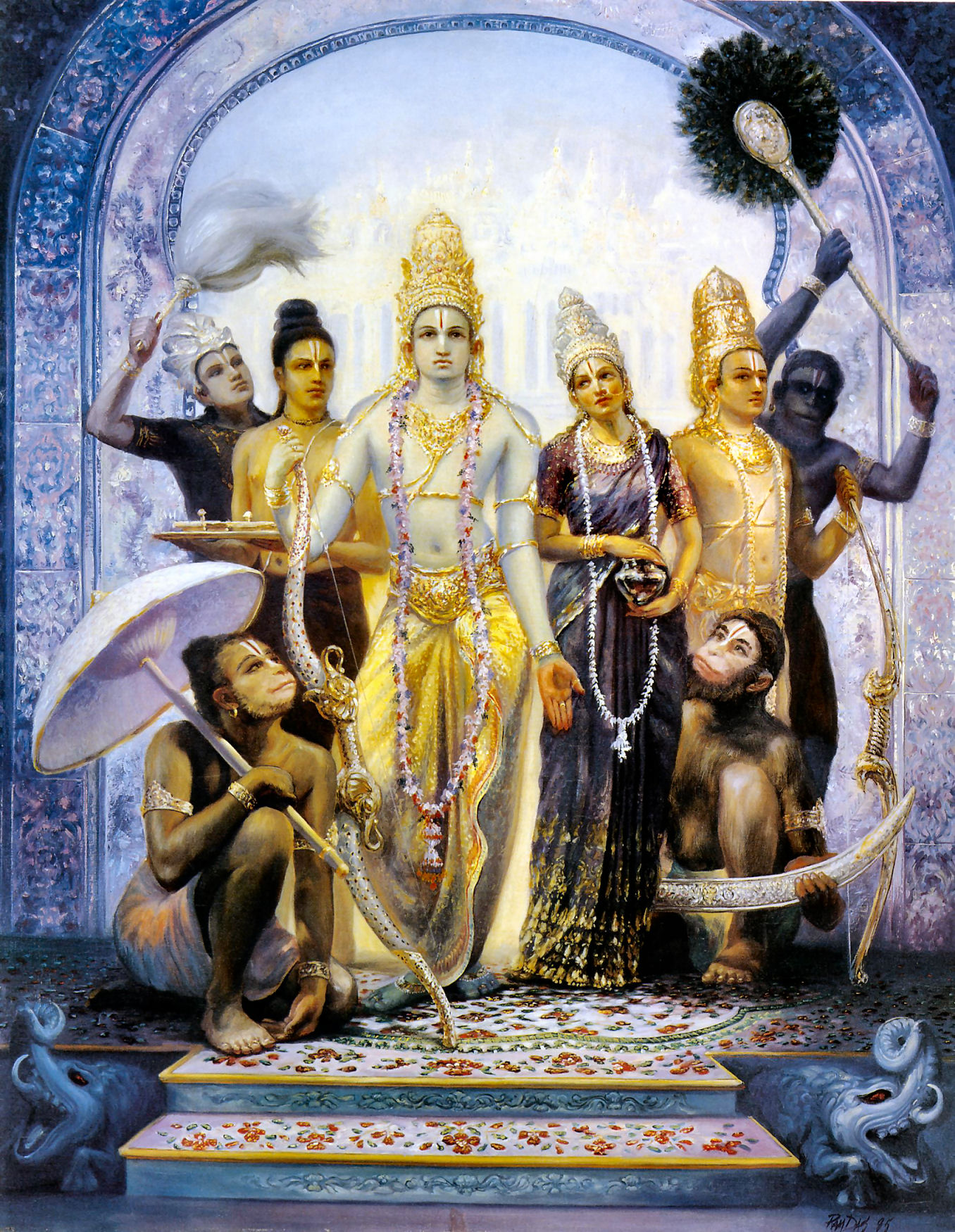
Then in accordance with Lord Ramachandra’s order, Vibhishana ruled Lanka. The Lord delivered Sitadevi from the Asoka forest and carried her in a flower airplane to His capital Ayodhya, where He was received by His brother Bharata.
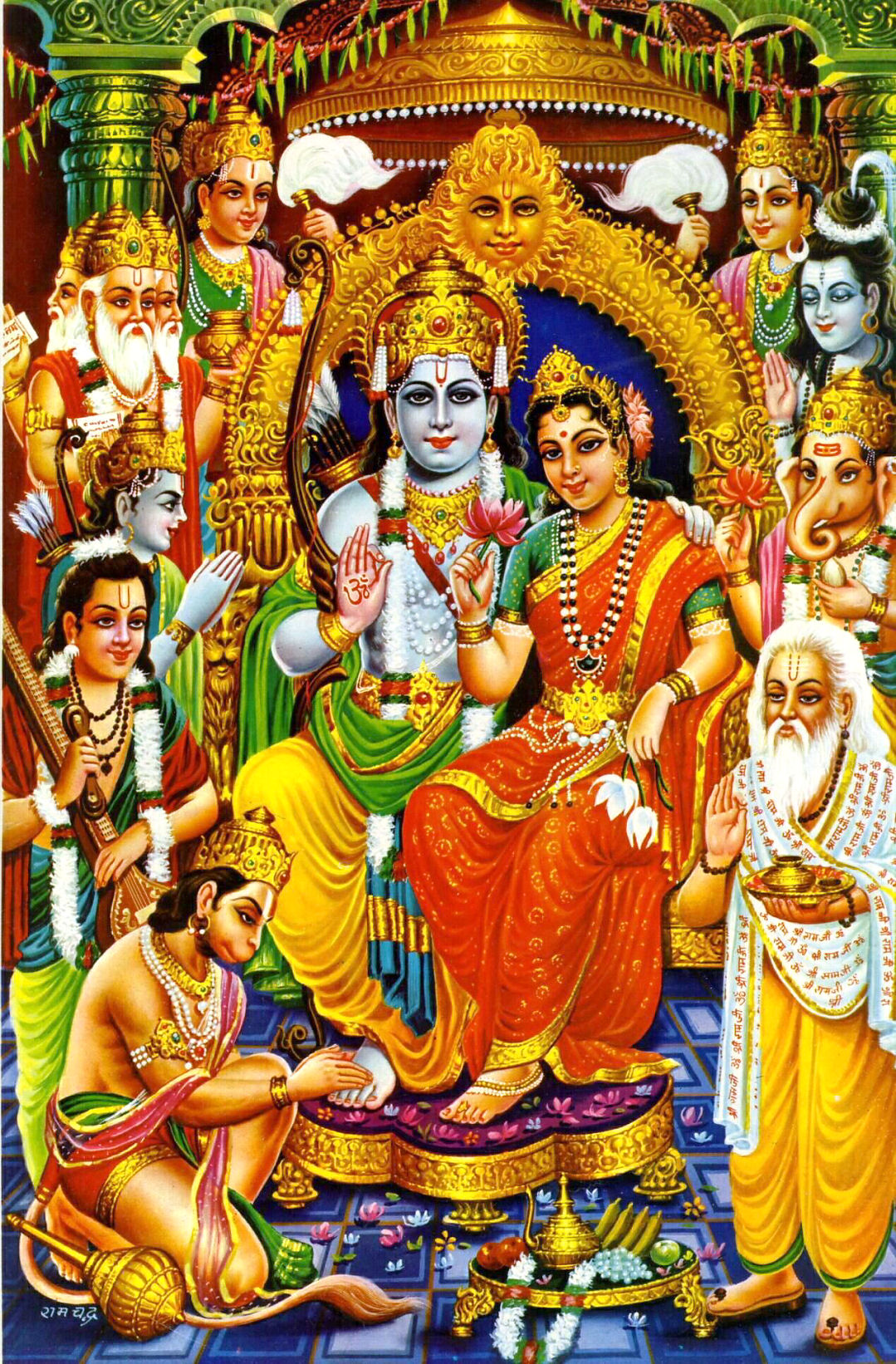
After Lord Ramachandra, accompanied by Lord Lakshmana and mother Sitadevi, met all His relatives, the great sage Vasistha enthroned Him as King and Lord Ramachandra ruled Ayodhya. He cared for the citizens exactly like a father, and the citizens, being fully engaged in their occupational duties of varna and asrama, accepted Him as their father. Lord Ramachandra became King during Treta-yuga, but because of His good government, the age was like Satya-yuga. Everyone was religious and completely happy. During the reign of Lord Ramachandra the forests, the rivers, the hills and mountains, the states, the seven islands and the seven seas were all favorable in supplying the necessities of life for all living beings.
When Lord Ramachandra, the Supreme Personality of Godhead, was the King of this world, all bodily and mental suffering, disease, old age, bereavement, lamentation, distress, fear and fatigue were completely absent. There was even no death for those who did not want it. All these facilities existed because of Lord Ramachandra’s presence as the King of the entire world. A similar situation could be introduced immediately, even in this age called Kali, the worst of all ages. It is said, kali-kale nama-rupe Krishna-avatara: Krishna descends in this Kali-yuga in the form of His holy name—Hare Krishna, Hare Rama. If we chant offenselessly, Rama and Krishna are still present in this age. The kingdom of Rama was immensely popular and beneficial, and the spreading of this Hare Krishna movement can immediately introduce a similar situation, even in this Kali-yuga.
Sunday, 18 March 2012 | By: Amandine Ronny Montegerai